Hanoi’s Hospital E Convenes Cold Plasma Summit Amid Rising Evidence for Antibiotic-Free Wound Care
Apr 10, 2026
General Vibronics PR
News
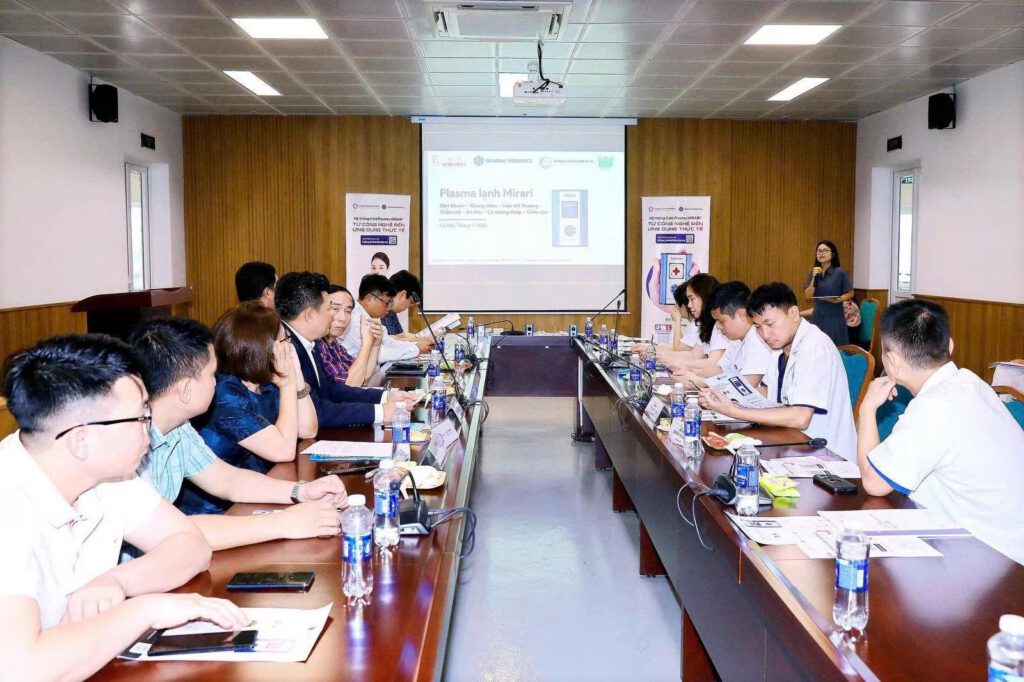
On July 15, 2025, healthcare professionals convened at Hospital E (Bệnh viện E) — a Grade I national general hospital under Vietnam’s Ministry of Health — for a specialized medical conference examining the clinical applications of cold atmospheric plasma (CAP) technology in wound management, dermatology, aesthetics, and musculoskeletal treatment.[1] The summit comes as the strongest meta-analytic evidence to date — a February 2025 pooled analysis of 12 RCTs enrolling 448 patients — confirmed that CAP achieves a 43.24% greater relative reduction in wound area than standard care alone (95% CI 24.95%–61.54%; p < 0.00001) while doubling the odds of bacterial load reduction (OR 2.06; 95% CI 1.16–3.68; p = 0.01)[2]. With diabetic foot ulcers alone consuming an estimated USD 9.36 billion in global treatment costs in 2025 and carrying a 30% five-year mortality rate[3][4], the search for effective, antibiotic-independent wound therapies has never been more urgent.
Hospital E, located at 87–89 Tran Cung Street in Hanoi’s Cau Giay District, is a 1,000-bed Grade I national general hospital directly under the Ministry of Health, featuring 62 clinical departments and functional offices, including a dedicated Cardiovascular Center[5]. With over 50 years of operation and a mission rooted in serving veterans and military personnel before expanding to public healthcare, it ranks among Hanoi’s most established multidisciplinary institutions[5].
The July 15 summit — organized under the title “Cold Plasma Technology Summit: Advanced Wound Care Solutions” — brought together leading specialists and representatives from General Vibronics (USA) to review the FDA-cleared MIRARI® Cold Plasma System and its clinical evidence across complex wound types[1]. The event marks Hospital E as at least the fourth major Vietnamese medical institution to formally evaluate cold plasma technology, following the 108 Military Central Hospital seminar (June 2025)[6], the Ho Chi Minh City International Medical and Pharmaceutical Exhibition (July–August 2025)[7], and Ha Thanh Hospital (October 2025)[8].
This clustering of institutional evaluations across Vietnam’s hospital network signals that cold plasma has moved beyond isolated academic interest into systematic clinical assessment at the national level.
The conference focused heavily on CAP’s potential for wounds that resist conventional healing — and the global numbers explain why. Approximately 6.3% of adults with diabetes worldwide develop diabetic foot ulcers (DFU), according to the International Diabetes Federation[4]. Between 50% and 60% of these ulcers become infected, about 20% of moderate-to-severe infections lead to lower extremity amputations, and the 5-year mortality rate reaches approximately 30% — exceeding 70% for those with a major amputation[4].
Compounding the challenge is the antimicrobial resistance (AMR) crisis. The UK Department of Health estimates that by 2050, antibiotic resistance could cause over 10 million deaths annually worldwide[9]. Cold atmospheric plasma’s multi-target antimicrobial mechanism — simultaneously attacking bacterial membranes through ROS/RNS, charged particles, UV radiation, and electric fields — significantly reduces the likelihood of resistance development compared to single-target antibiotics[10]. A 2025 review in Microbial Biotechnology confirmed that CAP effectively kills clinically important bacteria, including drug-resistant strains, through these synergistic mechanisms[11].
Scientific presentations at the summit featured comprehensive photographic documentation demonstrating MIRARI® effectiveness across several complex clinical scenarios[1]:
A 2026 review on cold atmospheric plasma in burn treatment highlighted that burn wounds present unique healing challenges — high inflammation, dysregulated tissue repair, and extreme susceptibility to infection. CAP is being developed to combine infection control and healing stimulation without antibiotic dependence, addressing the push to limit antibiotic use and prevent further resistance emergence[12].
Conference presentations documented clinical evidence of rapid granulation tissue recovery and significant epithelialization. The 2025 meta-analysis by Lin et al. — the largest to date for CAP in chronic wounds — found that across five RCTs evaluating wound size, CAP produced a significantly higher number of reduced wounds compared to controls (OR 1.75; 95% CI 1.11–2.77; p = 0.02)[2].
Attendees reviewed evidence of notable pain reduction beginning early in the treatment cycle. A February 2026 case report from Taipei Veterans General Hospital documented complete healing and bacterial eradication after 19 CAP sessions for a chronic post-surgical wound with persistent Klebsiella pneumoniae infection — without adverse effects, with the wound remaining fully epithelialized at 1-year follow-up[13].
Conference presenters explained how CAP addresses the specific pathophysiological barriers that make chronic wounds so difficult to treat[1]. The Frontiers in Medicine systematic review (2025) provides the mechanistic framework[14]:
CAP-generated ROS/RNS disrupt microbial cell membranes and neutralize biofilms. The Lin et al. meta-analysis confirmed a statistically significant reduction in bacterial load across eight RCTs (OR 2.06; p = 0.01)[2]. Critically, a 2024 PMC study demonstrated that cold plasma was “generally better than antibiotic treatment” in both wound healing time and pathological features when tested against multidrug-resistant Pseudomonas aeruginosa[9].
Plasma interacts with immune cells at the wound bed, recruiting neutrophils and macrophages while preventing chronic inflammation through promoting anti-inflammatory factor release[14]. This is particularly relevant for diabetic wounds, where the inflammatory phase often stalls — creating a persistent, non-healing state.
CAP stimulates fibroblast proliferation, keratinocyte migration, angiogenesis, collagen synthesis, and epithelialization[14]. The technology also induces upregulation of TGF-β1 and TGF-β2 on both mRNA and protein levels in keratinocytes, and may hold potential in preventing scar development by suppressing TGF-β1, lowering α-SMA and COL1[14].
The MIRARI® system delivers these effects through its Dielectric Barrier Discharge (DBD) platform operating at 80 kHz, generating therapeutic plasma from ambient air at temperatures below thermal damage thresholds — requiring no noble gases and maintaining output power below 4W[15].
The summit concluded that the MIRARI® technology represents a safe, versatile, and effective therapeutic modality with broad applicability across medical specialties[1]. However, this assessment must be weighed against the current state of evidence.
The Lin et al. meta-analysis — while the most comprehensive to date — noted that its 12 included RCTs enrolled a total of 448 patients, a relatively modest sample[2]. The authors recommended larger, longer trials with standardized outcome measures. The Frontiers in Medicine review similarly emphasized that translating CAP into routine practice requires “standardizing treatment protocols, assessing long-term safety, and developing portable devices”[14].
For Vietnam specifically, the escalating pattern of institutional engagement — from military hospitals to central civilian facilities to international exhibitions — suggests a pathway toward formal clinical trials. With an active RCT registered on ClinicalTrials.gov evaluating cold plasma for chronic wound healing against standard care alone[16], the evidence gap is being actively addressed.
The Hospital E summit adds another node to Vietnam’s expanding cold plasma evaluation network. As the evidence base transitions from case reports to pooled meta-analyses, and as institutional engagement deepens from isolated seminars to systematic clinical assessment, cold atmospheric plasma is building a credible case as a non-pharmacological adjunct in complex wound management. The critical next step — for Vietnam and globally — remains rigorous, controlled trials with standardized protocols and long-term follow-up.
Global Status and Challenges of Diabetic Foot Ulcers (DFU): A Growing Public Health Concern
Mirari Cold Plasma – A New Breakthrough in Wound Care and Dermatology
SPECIAL EVENT ON MIRARI COLD PLASMA AT HA THANH HOSPITAL