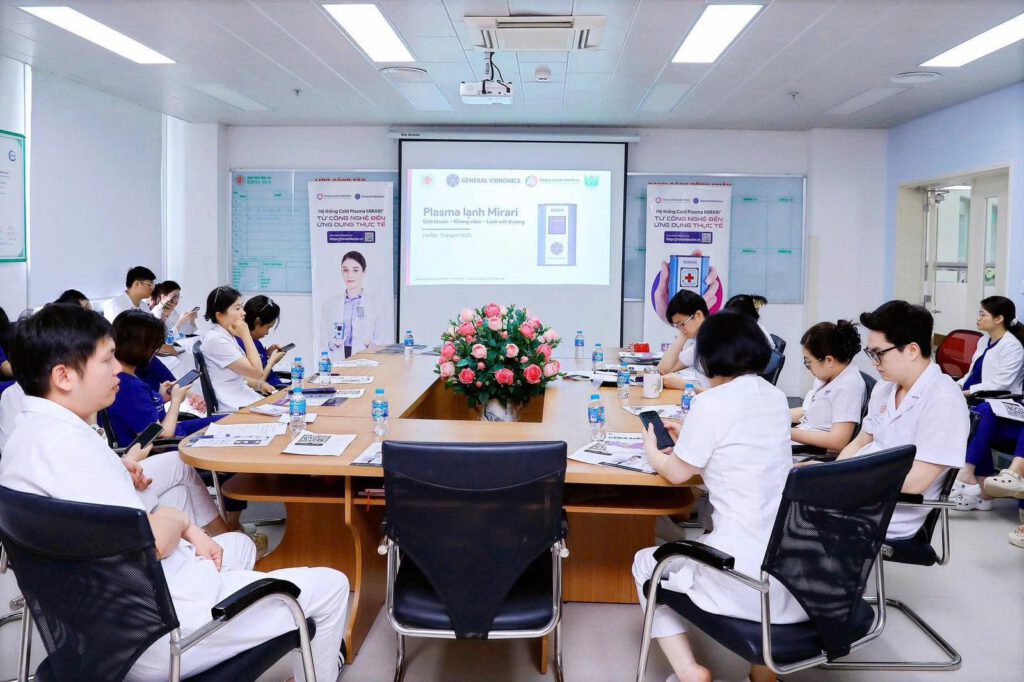
On June 18, 2025, the Dermatology Center at 108 Military Central Hospital — one of Vietnam’s five special-grade national hospitals and a strategic final-level care provider under the Ministry of National Defence — hosted a specialized seminar evaluating the clinical applications of cold atmospheric plasma (CAP) technology in wound care, dermatology, and non-pharmacological pain relief.[1] The event, titled “MIRARI Cold Plasma: Antibacterial – Anti-inflammatory – Wound Healing,” brought together medical experts, hospital leaders, representatives from General Vibronics (USA), and distribution partners to review clinical case reports and examine the FDA-cleared MIRARI® system’s mechanisms of action[1][2]. The seminar arrives as a November 2025 systematic review and meta-analysis of randomized controlled trials confirmed that adjunctive CAP therapy reduced final fractional wound area by 0.29 proportion units (95% CI −0.47 to −0.11; p = 0.002) in diabetic foot ulcers — the strongest pooled RCT evidence to date for cold plasma in chronic wound healing[3].
The significance of this seminar lies in its institutional host. 108 Military Central Hospital (Bệnh viện Trung ương Quân đội 108), located at No. 1 Tran Hung Dao Street in Hanoi, is a 2,000-bed special-grade national hospital expandable to 4,000 beds, with over 100 departments and 50 operating rooms[4]. Established in 1951, it holds the titles of Hero of the People’s Armed Forces and Hero of Labor — the highest civilian honor in Vietnam — and serves as one of the country’s leading centers for clinical research and advanced surgery[5][6]. In May 2025, just weeks before the cold plasma seminar, the hospital celebrated its 500th successful kidney transplant[7].
When an institution of this caliber convenes a dedicated forum on an emerging technology, it carries substantial weight within Vietnam’s medical establishment. The seminar was organized by the hospital’s Dermatology Center in collaboration with Mirari Import-Export Joint Stock Company — the exclusive distributor of MIRARI® devices in Vietnam[1].
The MIRARI® Cold Plasma System (GV-M2-01), designed and manufactured by General Vibronics at its U.S. headquarters in Tempe, Arizona, received FDA 510(k) clearance on November 21, 2024 (K242553), classified under 21 CFR 878.4400 as a Class II medical device[8]. The device is indicated for elevating tissue temperature for temporary relief of pain, muscle spasms, and increase in local circulation[9].
At the seminar, experts noted that the device won first prize at the Journal of Wound Care (JWC) Awards in London in 2017 for wound treatment and care, and received the Best Poster Award in 2016 (Italy)[1].
Associate Professor Dr. Nguyen Ngoc Tuan delivered the seminar’s keynote presentation on the mechanisms, indications, and clinical benefits of cold plasma technology[1].
Dr. Tuan explained that the MIRARI® system generates reactive oxygen and nitrogen species (RONS) with strong oxidative capabilities that eliminate pathogenic microorganisms while regulating cellular processes — including controlled proliferation, differentiation, and apoptosis — to support tissue regeneration and wound healing[1]. He highlighted a critical safety parameter: the output temperature of the plasma remains safely below 40°C, causing no thermal damage to living tissue[1][2].
These mechanisms are well-supported by independent research. A comprehensive systematic review published in Frontiers in Medicine in February 2025 confirmed that CAP generates ROS/RNS that accelerate tissue regeneration through fibroblast proliferation, keratinocyte migration, angiogenesis, collagen synthesis, and epithelialization — while simultaneously disrupting microbial cell membranes and neutralizing biofilms[10].
Clinical reports and photographic evidence presented at the seminar demonstrated the MIRARI® system’s effectiveness across multiple therapeutic domains[1]:
Case reports covered diabetic ulcers, burns, and post-surgical wounds. The global evidence base for CAP in diabetic wounds is strengthening: the November 2025 meta-analysis by Duda et al. — pooling 3 RCTs with 107 participants and 126 ulcers — found that the proportion of patients achieving ≥50% wound-size reduction by week 3 was significantly higher with CAP (RR 2.39, 95% CI 1.46–3.91; p < 0.001; I² = 0%), with no serious treatment-related adverse events reported[3]. Additionally, a February 2026 case report documented successful CAP-adjunctive therapy for a chronic post-surgical wound, achieving complete healing and bacterial eradication after 19 sessions[11].
Presentations addressed eczema, psoriasis, acne, nail fungus, and atopic dermatitis. A 2021 prospective clinical pilot study published in Nature Scientific Reports demonstrated that CAP significantly improved mild-to-moderate atopic dermatitis, with patients showing statistically significant improvement in pruritic VAS (p = 0.032), modified ADAS (p < 0.001), EASI (p = 0.002), and SCORAD scores (p = 0.001) — without any severe side effects including burns, prolonged erythema, or pain[12]. For psoriasis, a published case report demonstrated complete disappearance of a treatment-resistant palmo-plantar psoriatic plaque within 14 days after just two CAP applications[13].
The device was evaluated for musculoskeletal and post-surgical pain management, aligning with its FDA-cleared indication for temporary relief of pain and muscle spasms[9].
Assoc. Prof. Dr. Tuan emphasized that compared to laser therapy, cold plasma causes less pain, requires no prolonged downtime, and offers flexible control over treatment depth — minimizing risks of burns, scarring, or pigmentation disorders[1]. He stated:
“Cold plasma is a safe, effective, and versatile technology in modern medicine. However, standardized protocols must be developed in Vietnam, especially in dermatology and wound treatment, ensuring proper indication, multidisciplinary coordination, and close monitoring in clinical practice.”[1]
Dr. Tuan also noted contraindications: patients with pacemakers, severe infected wounds, or allergies to contact materials should not receive the treatment[1].
The 108 Military Central Hospital seminar represents the second major institutional event for cold plasma in Vietnam within a 12-month period — following a March 2026 international conference at Tue Tinh Hospital (Vietnam University of Traditional Medicine)[14]. Together, they signal that Vietnam’s leading medical institutions — both military and civilian, conventional and traditional — are actively evaluating this emerging technology.
Before-and-after treatment photographs displayed at the seminar showed rapid recovery within 3–7 days of MIRARI® Cold Plasma application for difficult wounds, nail fungus, inflammatory acne, and atopic dermatitis cases[1]. However, these remain case-level observations. As the Duda et al. meta-analysis cautioned, “larger, longer randomized trials are warranted to assess complete closure and recurrence outcomes and to define optimal treatment parameters”[3].
The European Wound Management Association (EWMA) similarly concluded in its October 2025 clinical document that CAP holds great promise as a sustainable advanced therapy but requires standardized protocols, expanded RCTs, and long-term safety assessments before routine clinical adoption[15].
The 108 Military Central Hospital seminar underscores the growing institutional interest in cold atmospheric plasma across Vietnam’s most prestigious medical facilities. As the evidence base advances — from single case reports to pooled meta-analyses of randomized trials — cold plasma technology is transitioning from experimental curiosity to a credible candidate for clinical integration. Formal controlled studies within Vietnam will be essential to bridge the gap between promising observations and evidence-based practice.
Mirari Cold Plasma – A New Breakthrough in Wound Care and Dermatology
Hội thảo “Plasma lạnh Mirari: Diệt khuẩn – Kháng viêm – Lành vết thương” – Bước đột phá mới trong chăm sóc vết thương và da liễu
108 Military Central Hospital
International Scientific Workshop on the Application of MIRARI Cold Plasma in Medicine Held at Tue Tinh Hospital
Cold Plasma: An Emerging Technology for Clinical Use in Wound Healing